Can iPhone Decibel Readings Help a Noise Complaint?
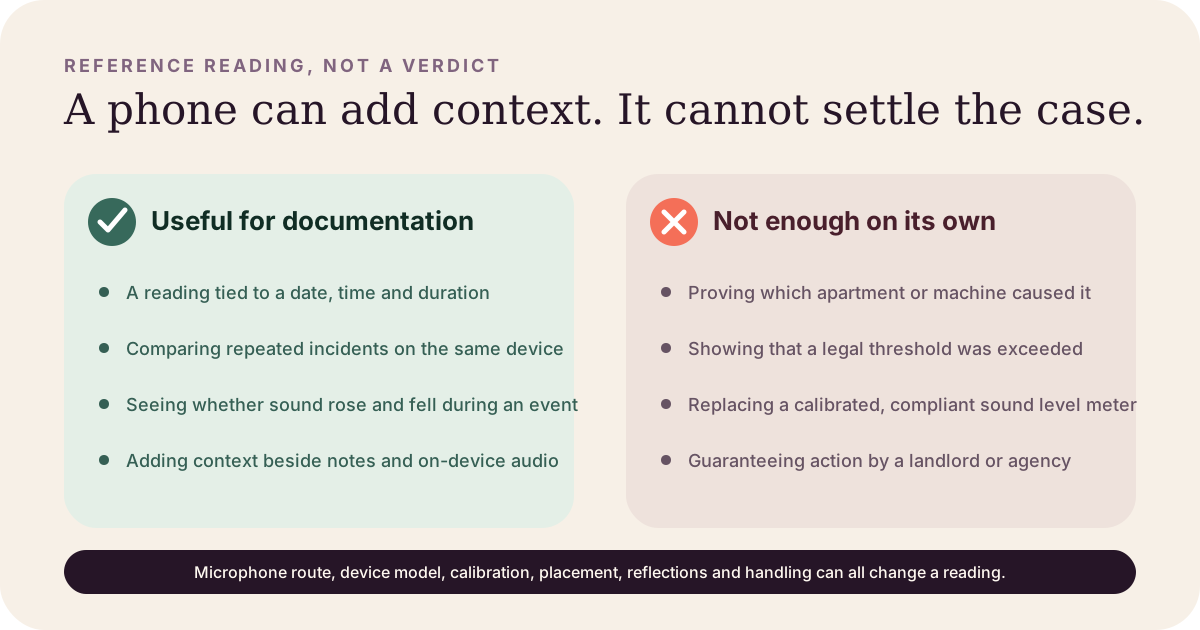
Yes—an iPhone decibel reading can help explain when a disturbance occurred and how its level changed during that incident. It is most useful when paired with a timestamped log, duration, room conditions, neutral notes, and repeated events. A phone reading alone does not prove a code violation, identify a source, or become a certified measurement simply because it displays dB.
Use an iPhone reading as a reference data point, not a legal conclusion. The strongest claim you can safely make is: “This is what this phone and app reported at this place and time under the conditions noted.”
What research actually says
Smartphones are not all equally accurate, and results from one tested app should not be generalized to every app.
NIOSH researchers tested sound-measurement apps against reference instruments in a controlled acoustics laboratory. Their 2014 evaluation found that some iOS app-and-device combinations produced results close to the reference, while performance varied by app and platform. A 2016 follow-up study found that a calibrated external microphone improved accuracy and precision.
The NIOSH Sound Level Meter app is a specific, government-developed iOS app. NIOSH says it was tested in its laboratory and is accurate within ±2 dBA; Type 2 performance requires a calibrated external microphone. Those validation statements apply to the tested NIOSH configuration—not automatically to SilentProof or another consumer app.
Measurement accuracy is only one part of choosing a tool: NYC Noise collects short readings for citywide analysis, NIOSH SLM focuses on workplace exposure, and SilentProof organizes a tenant’s recurring incident record. See the side-by-side comparison of NYC Noise, NIOSH SLM, and SilentProof before treating the three apps as interchangeable.
Real homes add variables that controlled tests do not remove:
- the iPhone model and microphone condition;
- the app’s signal processing and selected metric;
- cases, debris, hands, fabric, or furniture blocking a microphone;
- distance and angle from the source;
- walls, ceilings, reflections, open windows, and room furnishings;
- low-frequency bass or impact vibration that a phone may not represent well;
- short peaks versus a time-averaged level.
For these reasons, SilentProof labels phone measurements as reference sound levels.
What a phone reading can contribute
A reading becomes more useful when it answers a narrow factual question.
| It can help document | It cannot establish by itself |
|---|---|
| When an event started and ended | Who or what caused the sound |
| The pattern shown by the same phone in the same room | That two different phones are directly comparable |
| A reference range during a logged incident | That an official instrument would report the same number |
| Change from a similarly recorded baseline | That a lease or ordinance was violated |
| A timeline to accompany written notes | That a recording is admissible or lawful to share |
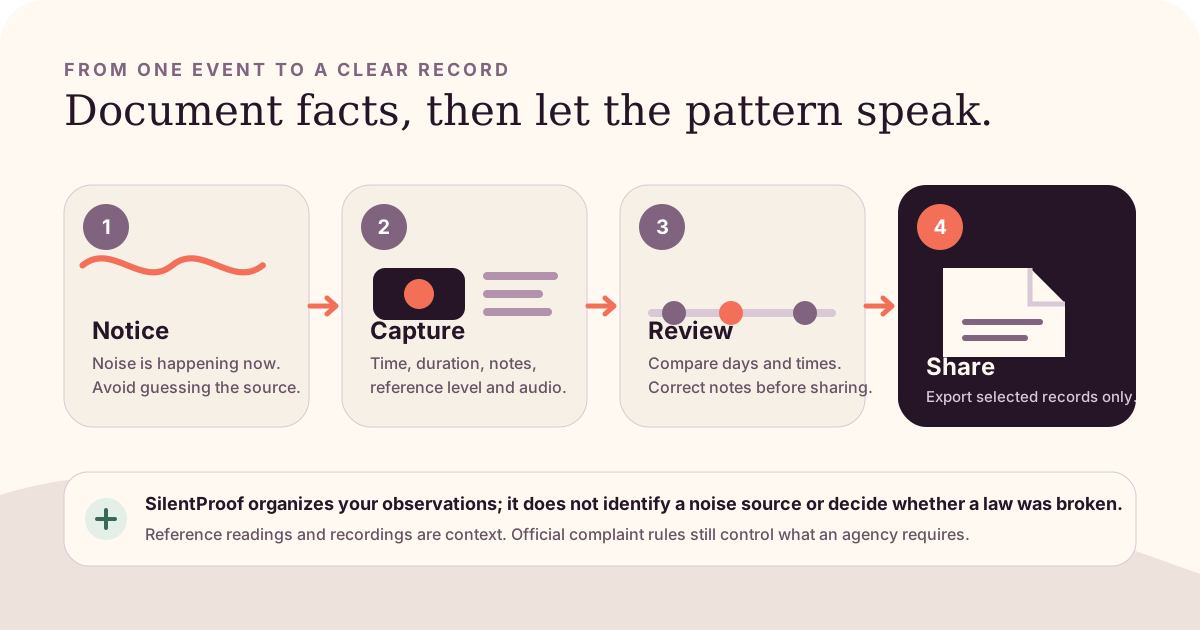
Think of the number as one column in an incident log. The date, duration, sound description, perceived location, effect on your home, and follow-up history provide the surrounding story.
A realistic example
Imagine bass is audible in your bedroom on four nights. You place the same iPhone on the same dresser, with the windows closed, and create an entry each time.
- Tuesday, 11:38–11:55 p.m.; intermittent low-frequency music; sleep delayed.
- Thursday, 12:09–12:27 a.m.; same perceived wall; woke from sleep.
- Saturday, 11:51 p.m.–12:42 a.m.; repeated bass; moved to living room.
- Sunday, 12:14–12:31 a.m.; same pattern after a building email was sent.
The useful finding is not “the neighbor produced exactly 64 dBA.” Your phone cannot establish the source or official level. The useful finding is that the same device, location, and method captured a recurring late-night pattern that aligns with contemporaneous notes.
How to make readings more consistent
You cannot eliminate uncertainty, but you can document the method and avoid obvious errors.
- Use the same phone and app. Do not compare your current iPhone directly with a friend’s Android reading.
- Choose a repeatable position. A bedside table or desk is easier to reproduce than holding the phone in the air.
- Keep microphones clear. Apple advises checking that iPhone microphone openings are not blocked and cleaning away debris when troubleshooting microphone quality. See Apple’s microphone guidance.
- Write down room conditions. Note open or closed windows, your room, and unusual appliances running nearby.
- Capture a baseline. A short reading in the same position when the disturbance is absent helps explain the change in your own environment.
- Record duration, not just the highest number. A screenshot of a momentary peak omits how long the event lasted.
- Do not chase a high result. Moving toward the wall, ceiling, hallway, or source changes the measurement and makes repeated entries less comparable.
- Preserve the entry. If you notice an error later, add a correction note instead of rewriting the original observation without explanation.
Why Voice Memos is not the same as a sound-level log
An audio clip can preserve what the microphone recorded, but playback volume does not reproduce the original sound pressure level. Phones and recording apps may apply gain control, compression, filtering, or microphone modes. Apple documents microphone modes such as Voice Isolation that can suppress ambient sound in supported contexts; that is useful for speech, but it demonstrates why a normal recording should not be treated as a calibrated level measurement.
An audio-only folder also lacks structure. Someone reviewing it still needs to know which clip matches which date, where the phone was, how long the disturbance continued, and why the event mattered.
If you capture audio, minimize incidental voices and sensitive information. Consent and privacy rules vary by jurisdiction and context. Read our recording-law basics before recording conversations or sharing files.
When you need a professional measurement
Consider an acoustical professional, code-enforcement inspection, or calibrated instrument when:
- a law or contract requires a specified meter class or measurement method;
- compliance turns on a narrow numerical limit;
- low-frequency, vibration, or building-transmission analysis is central;
- a dispute is headed toward formal proceedings;
- you need source identification, mitigation design, or expert testimony.
NIOSH itself notes that sound-measurement apps may provide an area-noise measure but may not comply with regulatory requirements. That distinction appears in its workplace measurement guidance and is equally important when a local residential procedure specifies official testing.
Where SilentProof fits
SilentProof is not a certified sound level meter. It is an iPhone workflow for keeping related information together while an incident is fresh:
- timestamped incident history;
- reference sound levels and a readable timeline;
- room, location, and context notes;
- optional local audio;
- PDF summaries for your own follow-up.
Records remain on-device by default. The free tier includes unlimited incident recording and one PDF export; Pro removes the PDF export limit with a one-time purchase. A PDF does not guarantee acceptance or action by a landlord, agency, insurer, mediator, or court.
If you need to start a structured record, review SilentProof’s noise complaint workflow. Then use our guide to documenting noise for a landlord to decide what context to add.
Bottom line
iPhone readings are most credible when the claim stays modest. Use one phone, a repeatable position, contemporaneous notes, and several events. Describe the output as a reference reading. If the applicable rule requires certified or official measurement, use the instrument and process that rule specifies.
This article is general information, not legal advice, an accuracy certification for SilentProof, or an opinion about whether a particular reading proves a violation.