Noise Measurement vs Audio Recording: U.S. Consent Law Basics
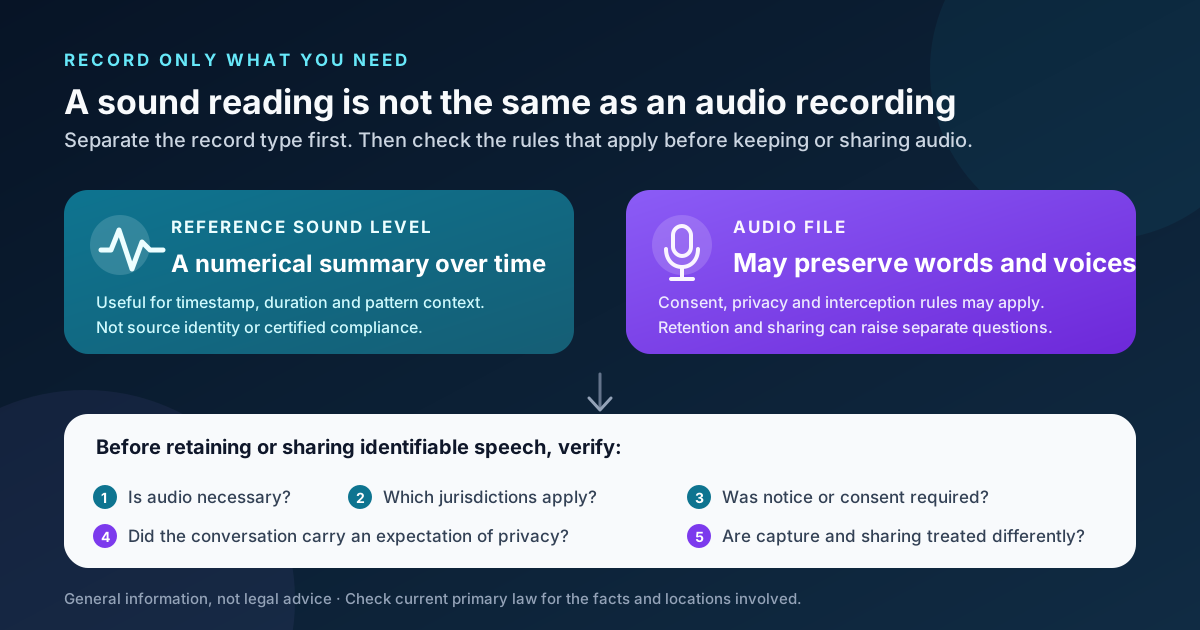
A sound-level reading and an audio recording are not the same record.
A reading summarizes sound pressure over time. An audio file can preserve words, voices, and the substance of a conversation. Once identifiable speech is captured, consent, privacy, interception, use, and disclosure rules may become relevant—even when your original goal was only to document noise.
This page is general information, not legal advice. Recording law changes and depends on facts that an app cannot determine. Check current law in every relevant jurisdiction or ask a licensed lawyer before capturing, keeping, relying on, or sharing identifiable conversations.
Sources reviewed: August 13, 2026.
Why a Two-Column State List Is Not Enough
The familiar “one-party state versus two-party state” list or color-coded map is too simple for a safe decision. “All-party consent” is the clearer term because a conversation may involve more than two people.
The answer can depend on:
- Whether the recording contains a protected wire, oral, or electronic communication
- Whether the conversation was private or confidential under the applicable law
- Whether the recorder was a participant
- Where the recorder and every participant were located
- Whether notice was given and how consent was expressed
- Whether an exception applies
- Whether the file is merely kept, submitted privately, or published
- How courts in that jurisdiction interpret the statute
The Reporters Committee for Freedom of the Press recording guide is a useful state-by-state orientation, but it is written for newsgathering and is not a substitute for current statutes or tenant-specific legal advice. The Digital Media Law Project overview explains the basic consent framework, but its educational summaries should also be checked against current primary law.
The federal baseline is not the final answer
18 U.S.C. §2510 defines covered communications, including an “oral communication” tied to an expectation that it is not subject to interception. 18 U.S.C. §2511 generally prohibits intentional interception and includes a party-or-one-party-consent exception in §2511(2)(d), subject to the provision’s limitations.
That federal rule is a floor, not a universal permission slip. States can impose stricter requirements, and a call or conversation involving people in different states can raise a choice-of-law question.
Official examples show why state labels are incomplete
These examples are not a complete state list and do not tell you which law governs your situation. They show how differently statutes are written:
- Texas: The Texas State Law Library recording guide describes Texas as generally a one-party-consent state, while also emphasizing reasonable-expectation-of-privacy and other limits.
- California: California Penal Code §632 addresses recording a “confidential communication” without the consent of all parties and separately defines when a communication is confidential.
- Florida: Florida Statutes §934.03 contains a general all-parties-prior-consent provision alongside specific exceptions.
- Massachusetts: Massachusetts General Laws ch. 272, §99 defines “interception” around secret hearing or recording without prior authority of all parties, with statutory exceptions and case-law context.
- Washington: RCW 9.73.030 generally requires consent of all participants for private communications and conversations, then states exceptions and a method for announcing a recording.
Reading only the label “one-party” or “all-party” can hide the most important words: private, confidential, participant, prior consent, and exception.
A safer decision process before retaining audio
1. Ask whether audio is necessary
For many noise complaints, timestamps, duration, a factual description, reference sound levels, and written correspondence can show a repeat pattern without preserving anyone’s words.
2. Assume speech may be captured
Walls and distance do not guarantee that a file contains only non-speech noise. If voices could be identifiable, treat the recording as sensitive until you have checked the law.
3. Identify every relevant location
For an in-person recording, note where it occurred. For a call or remote conversation, note where each participant was located. Do not assume the law of the recorder’s state is the only law that could matter.
4. Check participant status, privacy, notice, and consent
Being a participant can matter under one-party rules. It may not be enough under a stricter statute. Being inside your own home also does not automatically make another person’s private speech lawful to record.
5. Check the rule for sharing separately
Lawful capture does not automatically answer whether publishing, forwarding, uploading, or using the file in a proceeding is lawful or wise. Share only through the complaint channel that needs the file, and only after checking the applicable rules.
Lower-data documentation options
When audio is unnecessary, consider keeping:
- Incident date, start time, and duration
- Room or location where the sound was heard
- A neutral description of the sound
- Reference sound levels and a timeline
- Notes about windows, doors, or other context
- Prior complaint numbers and written responses
SilentProof can organize these details and export selected incidents as a PDF. It can also retain audio when you choose to record it, but SilentProof does not decide whether audio capture is lawful, certify a phone measurement, or determine admissibility.
Situations that need extra caution
- Recording a conversation you are not part of
- Pointing a microphone toward another residence or private area
- Capturing identifiable voices through a wall, door, or window
- Recording a call with participants in different states
- Uploading raw audio to a public portal without confirming it is requested
- Posting a recording publicly or sharing it beyond the complaint process
- Relying on an audio file in a legal or administrative proceeding
If audio may be important evidence, preserve the original file and metadata, limit access, and obtain jurisdiction-specific advice before editing or distributing it.
Where to verify
- Start with the RCFP state guide to identify the likely statute and issues.
- Open the current statute on the official state legislature or code website.
- Check whether recent court decisions have changed how the statute is applied.
- For interstate recordings or high-stakes use, consult a licensed lawyer or find civil legal aid.
Related SilentProof resources
The practical rule is simple even when the law is not: collect the least intrusive record that serves the complaint, and verify before retaining or sharing identifiable conversations.