How to Write a Landlord Noise Complaint Letter
A useful noise complaint letter does not need legal language or a dramatic claim. It needs a clear pattern, facts the recipient can review, and a specific request that fits the situation.
This page explains the decisions behind the letter: what to include, how to turn a log into a concise summary, what to ask management to do, and which attachments help. When you are ready to draft, use the separate copy-ready landlord noise complaint letter template.
Important: This is general information, not legal advice. Lease terms, notice rules, complaint channels, and tenant protections vary by property and jurisdiction. A non-emergency landlord letter is not the right tool for an immediate safety threat.
Start with the decision you want management to make
The request determines which facts belong in the letter. “Please fix this” is difficult to route; a specific next step gives the recipient something they can confirm, investigate, or answer.
| Situation you observed | A focused request |
|---|---|
| Recurring sound appears to come from another unit | Review the quiet-hours or conduct rule and confirm the next management step |
| Pipes, HVAC, doors, or equipment may be involved | Inspect the suspected building system or route the issue to maintenance |
| You already opened a building ticket | Confirm its status, responsible team, and expected follow-up date |
| The source is uncertain | Review the attached pattern and advise which building channel applies |
Do not demand that management punish a named person, guarantee silence, or agree that a law was violated. Ask for a review or action the recipient can realistically perform under the lease and building process.
Build the letter in six parts
- Identify the tenancy and purpose. Give the property and unit, and say that you are reporting a recurring noise issue.
- Summarize the pattern. State the date range, number of incidents, usual time window, affected room, and neutral sound description.
- Describe the effect. Explain an observable effect such as waking from sleep or interrupting ordinary use of the room; avoid unsupported medical or legal conclusions.
- Record prior steps. Include earlier building tickets, emails, or a safe courtesy message without retelling the entire dispute.
- Make one specific request. Ask management to inspect, review a rule, contact the appropriate party, request more information, or confirm the correct channel.
- Set up follow-up. Request confirmation and a reasonable written response date, then list the attachments you actually included.
The editable landlord letter template contains the complete copy-and-paste text and a one-click copy button. Keep this guide open while adapting the placeholders to your actual record.
Turn vague claims into reviewable facts
Vague:
The upstairs neighbor is always making illegal noise and management never does anything.
Reviewable:
From August 3 through August 12, I logged six incidents of repeated impacts and furniture-like scraping audible from the bedroom ceiling area, usually between 10:48 p.m. and 1:17 a.m. Four incidents woke me. I cannot confirm the exact source. Please review the building’s quiet-hours and floor-covering rules and advise the next step.
The revised version separates observation from conclusion:
- Observation: what you heard, when you heard it, and how often it repeated
- Context: where you were and how the pattern affected ordinary use of your home
- Uncertainty: what you could not verify about the source
- Prior steps: earlier emails, conversations, or service-request numbers
- Request: confirmation, any additional information needed, and a written next step
Avoid stating that a named person violated a law unless you have reliable information and appropriate advice. If you cannot identify the source accurately, describe where the sound appeared to come from instead of assigning blame.
What to attach
Send a short, reviewable package rather than a folder of unexplained files:
- A one-page incident summary or selected incident report
- Three to five recent examples showing the repeat pattern
- Prior written communication and case numbers
- A reference sound-level timeline, if available
- Audio only when it is necessary, accepted by the recipient, and lawful to capture and share
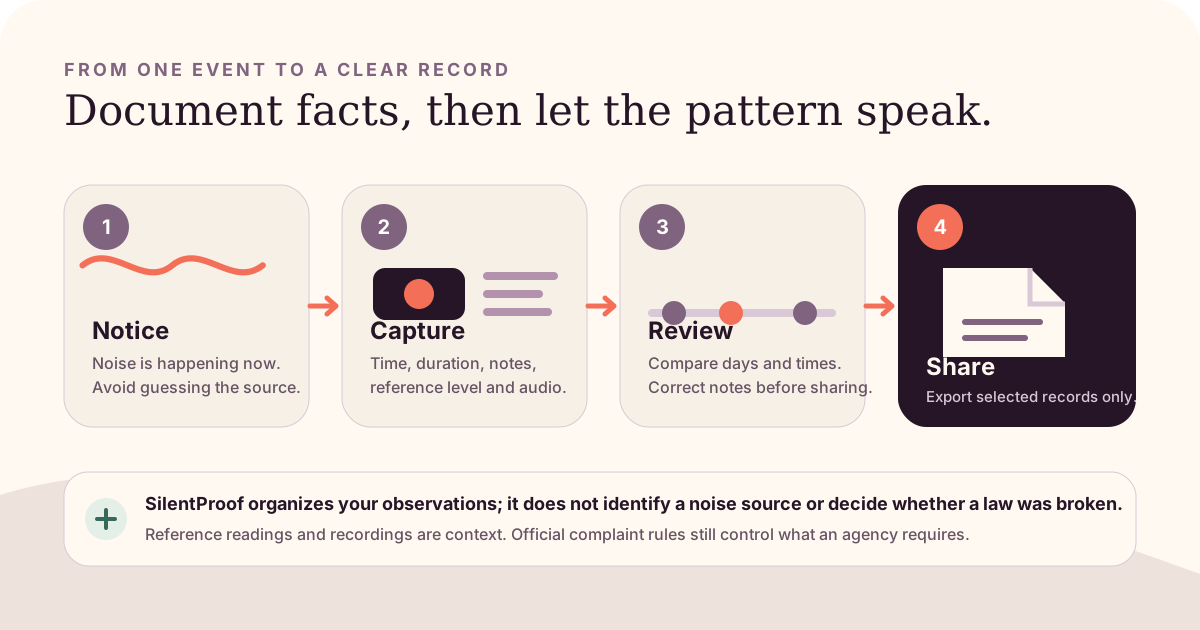
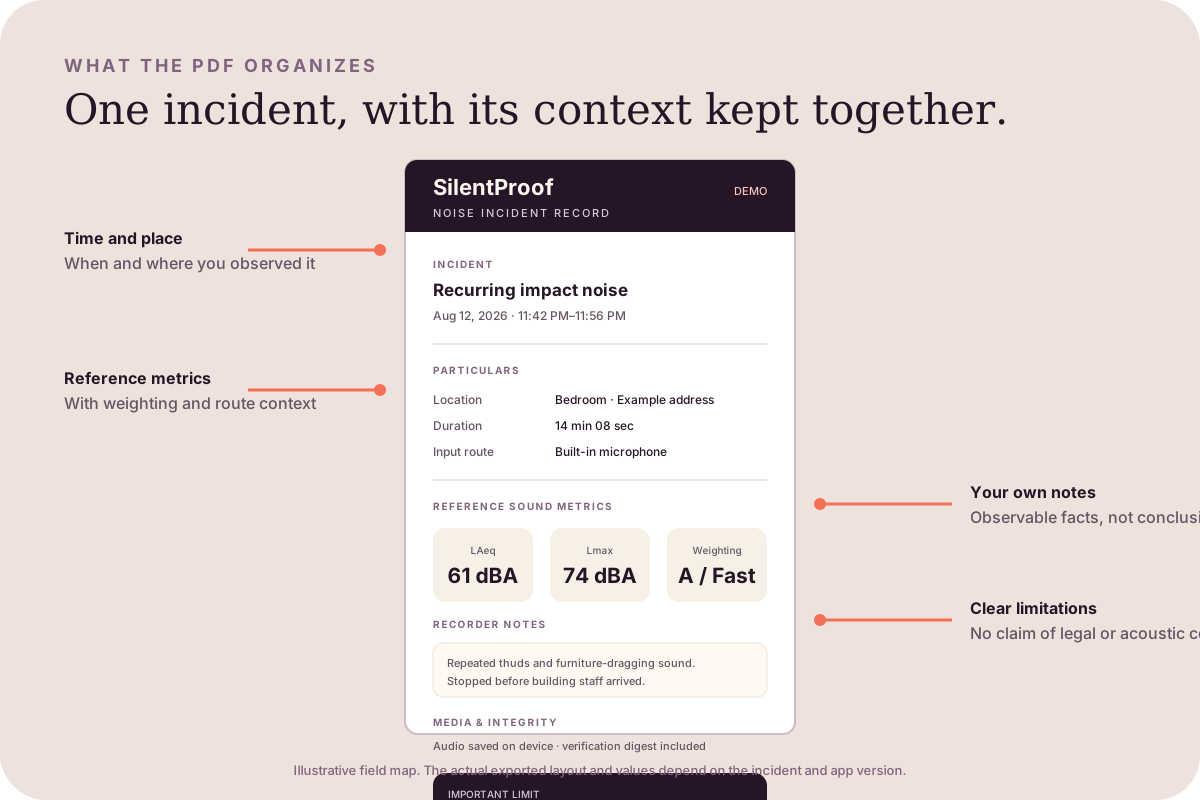
SilentProof can keep timestamps, reference sound levels, location context, and notes together, then export selected incidents as a PDF. A phone reading is contextual documentation, not a certified sound-level measurement, and an export does not guarantee enforcement or a particular legal result.
Before attaching audio, read Noise Measurement vs Audio Recording: Consent Law Basics. Recording and disclosure rules can differ by state and by the circumstances of the conversation.
Before you send
- Replace every bracketed placeholder and delete unused lines
- Check your lease for the correct notice address or portal
- Use dates and time windows instead of words such as “always” or “constantly”
- Describe sounds and impact you personally observed
- Choose a response date that is realistic for the situation
- Keep a copy of the sent message, attachments, and delivery confirmation
- Remove unnecessary personal information before sharing an export
If management does not respond
Follow up in writing and reference the original date. Depending on your location and the source of the noise, the next channel may be a local 311 service, a non-emergency agency line, a tenant association, mediation, or legal aid. There is no single national escalation route.
Use the 311 Noise Complaint Script only after confirming that your city accepts that type of complaint through 311.
Reliable next-step resources
- USA.gov: How to file a complaint against a landlord — links to state tenant-rights agencies and housing resources
- Legal Services Corporation: Find legal aid — locate an LSC-funded civil legal-aid organization
If the dispute involves threatened eviction, retaliation, discrimination, disability accommodation, or another high-stakes housing issue, get jurisdiction-specific advice before relying on a general template.